How to Do the Snatch Correctly (And Where Most Lifters Go Wrong)
The six phases, the five faults, and what to fix first.
7 Sections
To do the snatch correctly, the bar travels from the floor to overhead in one continuous motion: a controlled first pull off the floor, an explosive second pull through full extension, a fast turnover under the bar into a stable overhead squat position, and a strong stand to finish. Most technical breakdowns happen in the transition between the first and second pull, or when you catch the bar too far forward. Max Aita, head coach and founder of Team Aita, breaks the lift into its real phases, the mistakes that show up most often, and exactly what to fix first.
The snatch scares people. The bar goes from the floor to locked out over your head in about a second, and if nobody has ever shown you how, it looks like a magic trick. But the lift gets less mysterious when you learn the positions, then learn to connect them. I've taught this lift to athletes starting from a PVC pipe, including people who picked up weightlifting in their 40s and 50s, and the process is the same every time.
Is This You? Quick Self-Check
This guide is for the barbell snatch, the first of the two lifts contested in Olympic weightlifting. Read the two columns below and see where you land.
✓ This guide is for you if
- You've never snatched a barbell and want to learn it the right way from the start.
- You've been snatching for a while and your numbers have stalled.
- You miss lifts forward and don't know why.
- You learned the lift in a group class and never had anyone fix the details.
✗ This guide is not for you if
- You're looking for the dumbbell or kettlebell snatch. Those are different exercises and aren't covered here.
- You want a quick workout finisher and don't care about technique.
If you're in the left column, keep reading. Everything below is how I teach the lift at my Oakland gym and online through Team Aita.
How to Do the Snatch Correctly, Step by Step
The Soviet coaches broke the snatch into phases decades ago. R.A. Roman's The Training of the Weightlifter and A.N. Vorobyev's A Textbook on Weightlifting both describe the pull as a series of connected stages, each with its own job. Greg Everett at Catalyst Athletics uses a very similar breakdown today. I teach it in six pieces: learn each one on its own, then put them together.
1. Setup and Starting Position
Stand with your feet about where you'd put them for a vertical jump, roughly hip-width, toes turned out a little. The bar sits over the balls of your feet, close enough that it nearly touches your shins. Take a wide snatch grip with a hook grip, wrapping your thumb under your first two fingers.
From there, push your hips back and down until your hands reach the bar. Your shoulders should be slightly in front of the bar, your back flat and tight, your arms long with the elbows turned out to the sides. Your hips end up higher than your knees for most people.
Most common faultSitting the hips too low, like a squat. It feels strong, but the moment the bar breaks the floor, the hips shoot up to find the right position anyway, and now the bar is out of place.
The cue I use"Shoulders over the bar, bar over the foot."
2. The First Pull
The first pull takes the bar from the floor to just above the knees. You push the floor away with your legs and keep the angle of your back about the same as it was at the start. As the knees straighten, they move back, out of the bar's way, and the bar travels slightly back toward you.
This part should be controlled. Roman and the other Soviet texts describe the speed building through the pull, with the fastest part saved for the top. If you rip the bar off the floor, you usually lose position and can't get that speed.
Most common faultThe chest dropping and the hips rising faster than the shoulders. The bar then drifts out in front of the knees, and you're stuck pulling it from too far away.
The cue I use"Push the floor, keep your chest over the bar."
3. The Transition
Once the bar passes your knees, your knees slide forward and back under the bar, your torso gets more upright, and the bar moves up your thigh toward your hip. The Soviet literature calls this the transition or amortization phase. Coaches often call it the double knee bend.
Here's something important: you don't need to force this. When the first pull is right, and you stay over the bar long enough, the knees come forward on their own. Most of the athletes I see who "practice the double knee bend" end up with an extra, slow dip in the middle of the lift.
Most common faultRushing. People target the hip and yank the bar there, or they jump from mid-thigh before the hips are in position.
The cue I use"Be patient. Let it come to you."
4. The Second Pull
This is the explosion. With the bar high on your thighs and close to the hip crease, you drive your legs and hips to full extension as hard as you can. Hips open, knees straighten, and you come up on the balls of your feet because you pushed the floor that hard. The shrug happens at the finish, after the legs.
Keep your arms long and loose throughout. They are connectors here. Everett makes this point repeatedly at Catalyst, and I completely agree: early arm bend kills more snatches than anything else.
Most common faultBending the arms before the legs finish. It slows the bar down and usually sends it swinging away from you.
The cue I use"Legs first, arms last."
5. The Turnover and Catch
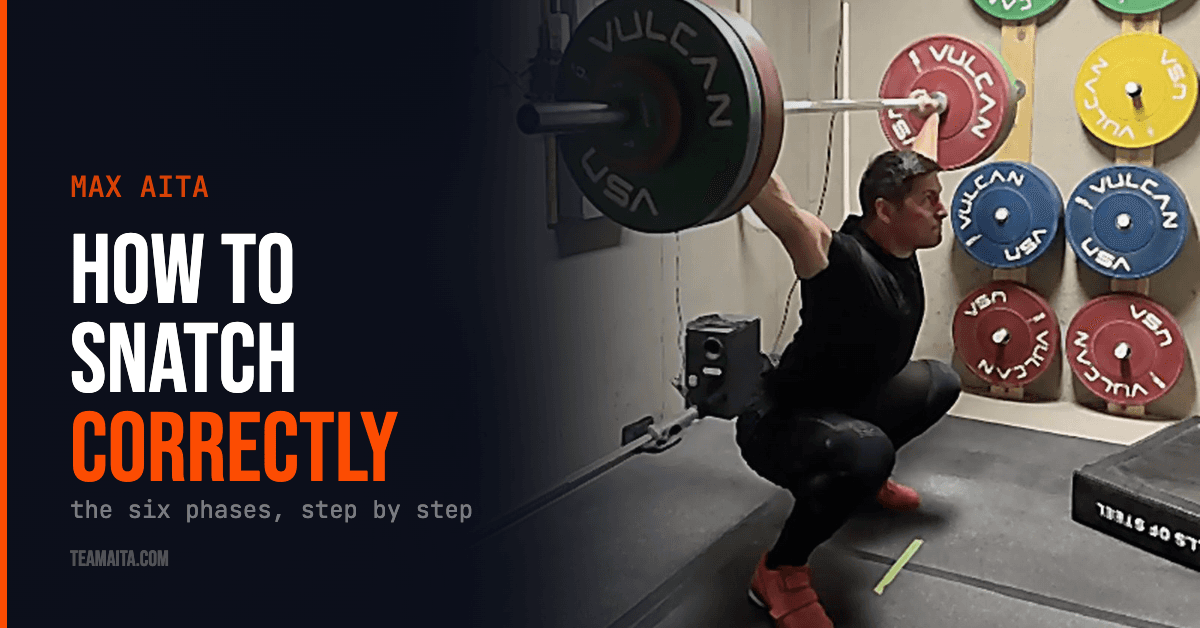
At the top of the extension, the bar is moving up, and you need to get under it. You pull yourself down with your arms, elbows high and out to the sides, keeping the bar close to your body. Your feet leave the floor briefly and land in your squat stance, a little wider than your pulling stance, flat-footed.
As you drop, punch up into the bar so your arms lock out as you hit the receiving position. The bar should end up over the middle of your foot, slightly behind your head, with your shoulders active and pushing up into it.
Most common faultCatching the bar out in front. It almost always comes from the bar drifting during the pull or from a passive, slow turnover.
The cue I use"Pull under, punch up."
6. Standing Up and Finishing
Once you've caught the bar, get stable in the bottom before you stand. Stay tall through your chest, keep pressing up into the bar, and drive up with your legs while the bar stays over the middle of your foot. At the top, bring your feet back in line and hold the bar still.
In competition, you have to hold it motionless until the referees give the down signal. In training, I have athletes hold every rep for a full second or two at the top. It builds control and the habit of finishing.
Most common faultStanding up too fast from an unstable catch. The bar drifts forward on the way up, and you dump the lift halfway.
The cue I use"Own the bottom, then stand."
Reading the steps is one thing; having a coach watch your bar path and fix what's actually wrong is another. That's what Team Aita's coaching is built for. Start Free Trial →
Common Snatch Mistakes (and How to Fix Them)
These are the five I see most in my gym and in the videos athletes send me. Fix them roughly in this order, because the early ones usually cause the later ones.
Hips Shooting Up Off the Floor
The bar breaks the floor, and the hips rise before the shoulders do. Now your chest points at the floor, and the bar pulls you forward. This usually comes from starting with your hips too low or from weak back and legs. The fix is slow, paused work. Snatch deadlifts with a two-second pause just below the knee teach you to hold your back angle and feel the bar stay close. Do them light and do them often.
Bending the Arms Too Early
The elbows bend before the legs finish driving. People do this because it feels like they're helping the bar up. In reality, the arms are tiny compared to the legs and hips, and pulling with them early slows everything down. The fix is to snatch from a position where you use your legs, like a hang snatch from the hip, and think long, loose arms. Tall snatches, where you start standing on your toes and pull yourself under, also teach the arms their real job.
The Bar Swinging Away From You
The bar drifts forward off the thighs or loops out in front at the top. Most of the time, the hips bump it forward, or the lats don't keep it close during the first pull. Think about sweeping the bar back toward you off the floor and keeping it brushing your legs the whole way up. Hang snatches from just above the knee are great here because you start in the exact spot where the bar tends to wander.
Cutting the Pull Short
The athlete starts pulling under before the hips and knees are fully open. It feels faster, but you're leaving power on the table, and the bar never gets high enough. Snatch pulls fix this. Load them a bit heavier than your best snatch and focus on finishing tall every single rep before anything else happens.
Catching the Bar Forward
The bar lands out in front of your head, and you chase it or dump it. Sometimes it's a pull problem, and sometimes it's an overhead problem. If the pull looks good, build the overhead position with overhead squats and snatch balances, holding the bottom for a few seconds. Your shoulders need to be strong and active in that position before you'll trust it with weight.
How Much Should You Be Able to Snatch?
I can't give you a single number, because bodyweight, age, sex, and training history all change the answer. A more useful way to look at it is your snatch as a percentage of your bodyweight. These are rough ranges I've seen hold up across the athletes I coach:
| Experience | Men (× bodyweight) | Women (× bodyweight) |
|---|---|---|
| First year of training | 0.5 to 0.8 | 0.4 to 0.6 |
| 2 to 4 years, consistent coaching | 0.9 to 1.2 | 0.7 to 0.9 |
| Advanced, competing nationally | 1.3 to 1.6 | 1.0 to 1.2 |
| Elite | 1.6 and up | 1.2 and up |
Two things to keep in mind. Lighter athletes tend to snatch a higher percentage of their bodyweight than heavier athletes, so a 61 kg lifter and a 109 kg lifter shouldn't measure themselves the same way. If you started lifting later in life, compare yourself to masters standards and your own last training cycle.
Another check I useYour snatch usually lands somewhere around 80% of your clean and jerk. If it's well below that, technique is likely holding you back more than strength.
Snatch Variations Worth Knowing
Medvedyev's A System of Multi-Year Training in Weightlifting lists dozens of snatch variations, each one changing the start position, the receiving position, or both. You don't need all of them. I program these four most.
Squat Snatch
This is the full competition lift, caught in a deep overhead squat. When people say "snatch" in weightlifting, this is what they mean. Everything in this guide is built around it.
Power Snatch
Same pull, but you catch the bar higher, with your thighs above parallel. Because you can't drop as low, you have to finish the pull harder and turn over faster. I use it to train speed and aggression, and on lighter days when an athlete's legs are beat up. Most athletes power snatch somewhere around 80% of their full snatch.
Hang Snatch
Start standing with the bar, lower it to a set position (hip, mid-thigh, or just above the knee), and snatch from there. Taking away the floor lets you focus on one part of the pull. It's one of the best tools there is for fixing the transition and the second pull, and I use it constantly with newer athletes.
Muscle Snatch
You pull the bar to full extension and then turn it over into the overhead position without re-bending your knees or dropping under it. The weights are light. It teaches the arms and shoulders the right path at the top of the lift, and it's a great warm-up and teaching drill. I also use it with athletes who need more strength through the turnover.
Frequently Asked Questions
What's the difference between "snatch and clean" and "clean and jerk"?
Weightlifting has two competition lifts: the snatch and the clean and jerk. In the snatch, you lift the bar from the floor to overhead in one movement. In the clean and jerk, you bring the bar to your shoulders first (the clean) and then drive it overhead (the jerk). There's no lift called the "snatch and clean." Your total in a meet is your best snatch plus your best clean and jerk.
What is snatch grip, and how wide should it be?
Snatch grip is the wide grip you use for the snatch. A simple way to find yours: stand tall, hold the bar with straight arms, and slide your hands out until the bar sits in the crease of your hips. Overhead, the bar should end up a few inches above your head. Some athletes go a little narrower or wider based on their shoulders and arm length, and that's fine.
What's a snatch pull, and should beginners do it?
A snatch pull is the pulling part of the snatch done to full extension, without pulling under the bar. You usually do it with weights at or above your best snatch, so it builds strength in the exact positions you need. Beginners can do them once their positions off the floor are consistent. Keep the weight moderate at first and make every rep look like your snatch.
Is the CrossFit snatch different from the competition snatch?
The movement is the same lift. The difference is in the rules and how it's used. In CrossFit workouts, you often do the snatch for reps; a power snatch counts, and the standard is mostly about finishing with locked arms and open hips. In weightlifting competition, you get three attempts, a press-out is a no-lift, and you have to hold the bar still overhead until the referees say down. If you come from CrossFit, this guide's technique will make your workout snatches more efficient, too.
How long does it take to learn the snatch?
Most athletes I coach can snatch an empty bar with decent positions within a few weeks of practicing two or three times a week. Making that technique hold up under heavy weight takes years, and honestly, nobody ever stops working on it. If you're starting later in life, give yourself extra time to build mobility for the overhead squat. The progress still comes, and it's one of the most rewarding things you'll ever learn in the gym.
References
- Roman, R.A. The Training of the Weightlifter. Moscow: Fizkultura i Sport, 1986. English translation, Sportivny Press, 1988.
- Vorobyev, A.N. A Textbook on Weightlifting. Translated by W.J. Brice. Budapest: International Weightlifting Federation, 1978.
- Medvedyev, A.S. A System of Multi-Year Training in Weightlifting. Moscow: Fizkultura i Sport, 1986. English translation, Sportivny Press, 1989.
- Zhekov, I.P. Biomechanics of the Weightlifting Exercises. Moscow: Fizkultura i Sport, 1976. English translation, Sportivny Press.
- Everett, Greg. Olympic Weightlifting: A Complete Guide for Athletes & Coaches. 3rd ed. Catalyst Athletics, 2016.
- Catalyst Athletics exercise library and articles, catalystathletics.com
- International Weightlifting Federation, Technical and Competition Rules & Regulations, iwf.sport
Technique gets better faster with a coach watching
Team Aita pairs real coaching feedback with adaptive programming, so we catch the fixes you need. Start your 7-day free trial.
Start Free Trial →Start Your Weightlifting Journey
Join the team and start coaching with clarity — use data, readiness, and quality work to drive better sessions.