Chinese Weightlifting: What Modern Coaches Actually Took From It
Kept, and left behind — a coach's honest account.
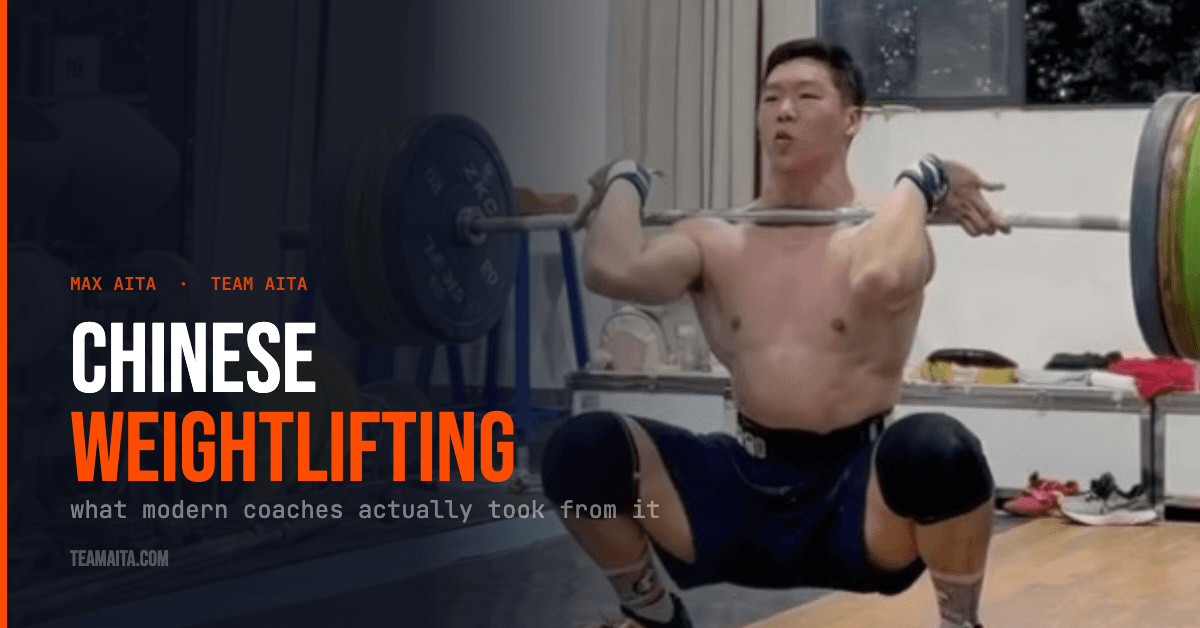
Chinese weightlifting has dominated the sport for decades, not because of some secret method, but through a system that integrates technical mastery, individualization, and a culture built around a relentless pursuit of excellence. As Max Aita, I've been lucky enough to witness what the Chinese actually do beyond the mystery and the highlight reels. In this blog, I'll discuss my honest thoughts of what modern coaches can actually take from the Chinese system and what should be left behind.
Understanding this system matters for more than just admiration. If you're serious about your own lifting or coaching, the Chinese approach is worth studying because it isolates what actually drives very high achievement: technical mastery, individualization, and consistent execution.
We covered the Soviet system in an earlier post; this is its modern counterpart, and the two systems make a lot more sense side by side than they do in isolation.
What the Chinese Weightlifting System Actually Is
The Chinese are not actually doing anything unique or special in the greater context of weightlifting training; they have barbells, bumpers, platforms, coaches, athletes, same as everyone else. What they do better than nearly every other country is execution. They repeatedly execute all things within the system to the greatest extent possible.
"We are what we repeatedly do; therefore, excellence then is not an act, but a habit." — Aristotle
That quote is a better description of the Chinese weightlifting system than most of the conjecture that ends up on the internet. In large part, the system is a variation of the Soviet model of athlete development but with its own defining emphasis layered on top: technical mastery as the foundation for everything. Loading follows technique, and every other principle in the system exists to support this.
It starts with recruiting and talent identification at a young age, paired with long-term athlete development. The Chinese model isn't concerned with producing the most impressive 12-year-old lifter for a highlight reel; it's built around developing Olympic and world champions a decade or more down the line. Early development focuses on building a large base of general physical qualities before specialization narrows. Programming is highly individualized, with a moderate variety of exercises used to correct specific weaknesses. However, I would say the exercise pool is not as large as the Soviets historically used, but still far from the Bulgarians of the 1980-90s.
Training volume grows steadily in the early years of an athlete's development, followed by a shift toward intensification later in their career, once the technical foundation and physical base are already in place. Constant, real-time coaching correction runs through all of it.
This is self-evident in any training hall; you can watch the Chinese team doing bar warmups and technique work with light weights before and after the competition date. It's so obvious how much emphasis is placed on the quality of movement and the execution of the technique.
What the Chinese Weightlifting Program Actually Looks Like
At the elite level, a Chinese weightlifting program is demanding by almost any standard; eight to ten training sessions a week is typical, and the routine on any given day is built around whatever the athlete's weaknesses call for. Exercise variety is moderate: not as sprawling as the old Soviet system, but far from a narrow rotation of just the competition lifts. Accessory work is a significant part of the program, and bodybuilding-style elements show up alongside the classic and special exercises to address muscular weaknesses and support technical work.
Exercise selection is driven by the individual athlete's weaknesses, identified and corrected session by session. That's the detail that maybe gets lost when people try to copy the Chinese weightlifting routine directly: the routine on paper is just the plan. The coaching, the culture, and the system around it are what make it actually work. A full-time coach watching every rep, correcting technique in real time, and adjusting the next session based on what they just saw — that infrastructure is what makes the volume and frequency actually productive instead of just exhausting. Take away the coaching presence and the same routine stops working the way it's supposed to.
The coaching infrastructure behind the Chinese system is exactly what Team Aita is built to give you, even if you're not training full-time. Start your free trial →
The 3 Chinese Principles I Actually Use
Technical Mastery: The Cornerstone of the Chinese System
The Chinese system is ruthless about technique. This is present at all times. Almost no training sessions are without coaching guidance; this makes it extremely hard for technical sloppiness to creep into the athlete's performance. This is the principle we strive to adhere to most at Team Aita; it's why we built an entire ecosystem around real human coaches delivering feedback day to day. You simply cannot improve at the same rate without coaching; a training program cannot do it alone.
Weakness Correction as the Driver of Exercise Selection
Chinese coaches don't run a fixed template and hope it fits. They observe the athlete, identify the actual weakness, and program around it. That's exactly what adaptive programming is built to do: not one program for every athlete at a given level, but a system that adjusts exercise selection and emphasis based on how the individual athlete is actually responding. The training program is the canvas for individualization.
Coaching Presence in Every Session
Chinese athletes, as do all high-level athletes, get coached every single session; there's no such thing as training in a vacuum in their world. Most athletes training outside a full-time program don't have a coach standing on the platform watching every rep. Being connected to real coaches is critical for success; it drives better performance, more accountability, and is the tried-and-true method for achieving high performance.
The Chinese principles described above — technical mastery as a cornerstone, individualization, and coaching presence in every session — are built into Team Aita's entire system. We use technology where appropriate to build better programs and make it effortless to access our coaches, then set you up for success with real, exceptional feedback and technical coaching in the app.
Technical Mastery, Built Into Every Rep.
Put these principles to work in your own training.
Start Free Trial →What Doesn't Translate — And Why
The Chinese system assumes a full-time training environment most athletes simply don't have: multiple sessions a day, an embedded coach watching every rep, institutional support built around producing elite performance over a decade or more. Copying the volume and frequency wholesale, without that infrastructure underneath it, doesn't get you the same results.
The honest conclusion is straightforward: the principles are sound. The specific programs are not. Technical mastery, individualization, and consistent coaching feedback all translate to any athlete, at any level. Eight to ten sessions a day, built for a full-time athlete inside an institutional system, does not.
Chinese vs Soviet Weightlifting — The Key Difference
The single most important distinction, in my opinion: the Soviet system is periodization-first — its genius is in the planning and sequencing of training over time. The Chinese system is technique-first — its genius is in the relentless, session-by-session enforcement of correct movement, with periodization built to serve that goal rather than the other way around. Both systems care about both things. The difference is which one is treated as non-negotiable and which one bends to serve it.
In practice, I use both. The Soviet emphasis on planned, wavy periodization gives the long-term structure — how training stress builds and unloads across a cycle. The Chinese emphasis on technical mastery gives the daily discipline inside that structure — the refusal to let load outrun position. Neither system on its own is complete. Combined, they cover both the long-term plan and the daily execution that plan actually depends on. For the full breakdown of what I took from the Soviet system, that's covered in an earlier post.
Frequently Asked Questions
Why is Chinese weightlifting so dominant?
It's not because Chinese athletes simply work harder — that explanation misses what's actually happening. Three things drive it: technical mastery treated as the non-negotiable foundation, individualized coaching infrastructure that corrects every athlete in real time, and long-term athlete development that starts young and is built around producing champions a decade later, not immediate results.
What is the Chinese weightlifting system?
It's a technique-first approach to weightlifting development: load never outruns technical readiness, exercise selection is driven by correcting each athlete's specific weaknesses, and training frequency at the elite level is high, with constant real-time coaching correction. The system is really the coaching environment itself — the program on paper is secondary to that.
How do Chinese weightlifters train?
At the elite level, expect high frequency — eight to ten sessions a week — with moderate exercise variety, significant accessory and bodybuilding-style work supporting the classic lifts, and real-time coaching correction in every session. A typical week is built around correcting each athlete's individual weaknesses, not running a fixed template.
Can I use the Chinese weightlifting program?
Honestly, the principles, yes. The exact program, no. Take technique-first progression, weakness-driven exercise selection, and constant coaching feedback; those translate to any athlete. Leave behind the volume and frequency, which are built for full-time athletes inside an institutional system most people training outside it don't have access to. You can see how these principles combine in my full programming system if you want the practical version of all this.
The System That Wins. Applied To You.
Team Aita takes the principles that make Chinese weightlifting dominant and delivers them through an adaptive program and coaching team. Start your 7-day free trial.
Start Free Trial →Start Your Weightlifting Journey
Join the team and start coaching with clarity — use data, readiness, and quality work to drive better sessions.