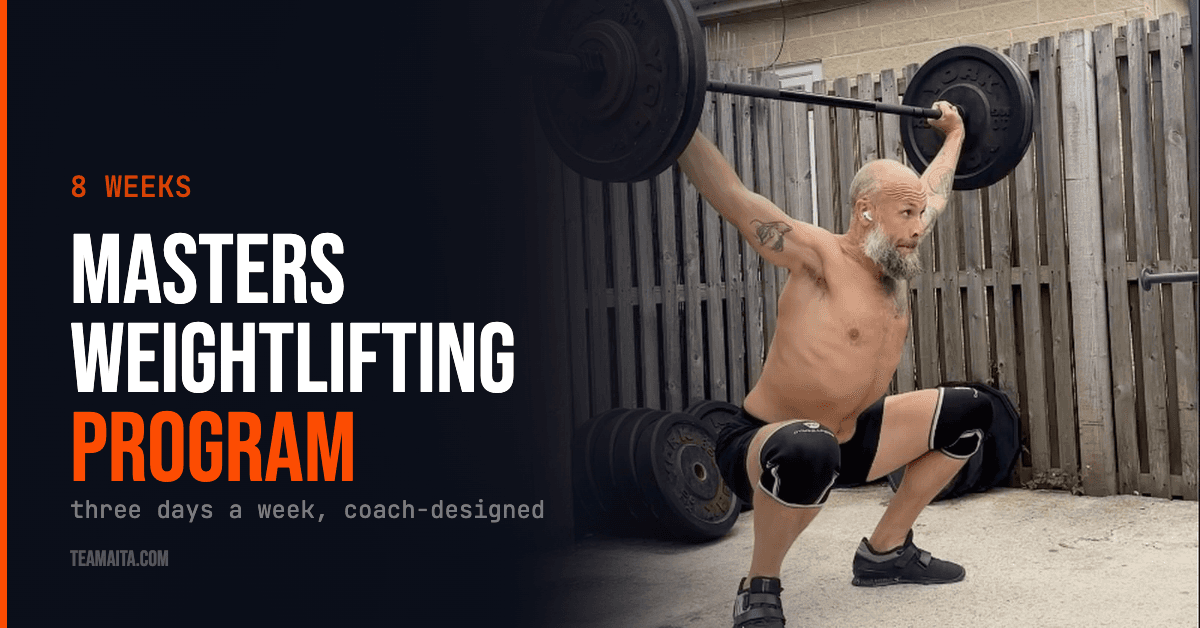
The Masters Olympic Weightlifting Program: 8 Weeks, Coach-Designed
Three days a week, built for the recovery you actually have.
7 Sections
The best masters Olympic weightlifting program is a three-day-per-week program with a fourth optional training day for those who have exceptional recovery. Fatigue management is built into the program, with dense technical work starting the cycle off, while exposure to high-intensity lifts is carefully managed to avoid stagnation. This 8-week program is designed by Max Aita, head coach and founder of Team Aita, specifically for lifters 40 and older, whether returning to the sport or picking it up for the first time. Each session runs between 60 and 80 minutes. By week 4, you'll have a solid technical foundation in the snatch and clean & jerk with an increased work capacity that will help you recover during the second 4 weeks which will peak you for a test at the end of the 8 weeks.
Most programs fail masters lifters because they treat recovery, joint preparation, and volume tolerance as afterthoughts. I have coached weightlifters from their first day in the sport through national titles, international teams, and American Records, and this program applies the same principles to the actual constraints athletes over 40 face.
If you want the full reasoning behind why this program is structured this way, read this first.
Is This Masters Weightlifting Program Right for You?
✓ This is for you if
- You are 40 or older and want to improve the snatch and clean & jerk, not just perform generic strength training.
- You are returning after time away or have continued training but no longer recover well from programs written for younger lifters.
- You can commit to three sessions per week and usually leave at least one day between the main sessions.
- You have no acute injury that currently changes how you squat, pull, receive, or lock out the bar.
- You can train from honest current numbers rather than old lifetime PRs.
✗ This is not for you if
- You are under 40 and recover well from a conventional higher-frequency weightlifting program.
- You are currently injured, have unexplained pain, or have not been cleared to resume loaded training.
- You want to max out every week or turn every percentage range into a challenge to reach its upper limit.
- You cannot reliably train three days per week. A good program performed sporadically is still a poor training plan.
Being a masters athlete does not mean training without ambition. It means placing the right stress at the right time so your best work accumulates instead of being erased by fatigue.
What Does a Masters Olympic Weightlifting Program Actually Look Like?
A masters weightlifting program normally uses three primary sessions per week, longer joint and movement preparation, and enough technical repetition to improve the lifts without creating volume the athlete cannot recover from. Early weeks emphasize repeatable positions and work capacity at moderate intensity; later weeks reduce unnecessary volume and concentrate exposure to heavier snatches and clean & jerks. A fourth strength session can work for athletes with exceptional recovery, but it should remain optional and be removed before the three primary sessions are compromised.
Adaptive load adjustments, coaching cues, and progress tracking, built around the same principles. Start Free Trial →
What Masters Lifters Actually Need
Masters programming should always revolve around the needs of the athlete. You cannot take a program written for a 22-year-old, remove ten percent from the bar, and call it olympic weightlifting programming for masters. The problem is not only how heavy the bar is. The problem is how often stress is applied, how much tissue loading accumulates, and whether the athlete is actually restored before the next important session.
First, recovery windows must be built into the week. The Monday-Wednesday-Friday structure gives most athletes a full day between exposures and two days after the hardest session. Saturday is optional because adding work is only useful when it does not reduce the quality of the next week.
Second, joint preparation is part of training. Ankles, hips, thoracic spine, shoulders, elbows, and wrists must be ready to express the positions the lifts require. The warm-up is not filler, and it should not become exhausting. Its job is to improve range of motion, raise tissue temperature, rehearse positions, and tell you how your body is responding that day.
Third, technical density and high intensity should not peak at the same time. Early in this cycle, you accumulate a high number of technically controlled attempts without excessive loading. That creates a stable base and increases your ability to recover between attempts and sessions. Heavy classic lifts are concentrated later, when total exercise variety begins to narrow. This prepares you to attempt maximum lifts without exhausting your ability to recover during the first half of the cycle.
We cover why these three things matter in more depth here.
The Program: 8 Weeks, 3 Days per Week
Percentages for the snatch and its variations are based on your current snatch. Percentages for clean, jerk, and clean-pull variations are based on your current clean & jerk.
| Week | Focus | Intensity |
|---|---|---|
| 1 | Technical density and base strength | Mostly 50–80% |
| 2 | Repeat the structure with a small load increase | Mostly 53–83% |
| 3 | Highest workload of the first block | Mostly 55–90%; selected lifts to 95% |
| 4 | Deload while maintaining technical rhythm | Mostly 50–85% |
| 5 | Transition to heavier classic-lift singles | Mostly 60–95% |
| 6 | Increase specificity and heavy exposure | Mostly 63–98% |
| 7 | Peak exposure without forced misses | Mostly 65–100% |
| 8 | Taper and test | 50–92% before test day |
Joint-prep warm-up for every session
Spend 10 to 15 minutes preparing, then take normal barbell warm-up sets before the prescribed work:
- Three to five minutes of easy cyclical work to raise body temperature.
- Ankle rocks, controlled squat prying, and hip rotations for 6 to 10 reps per side.
- Thoracic rotations plus banded shoulder and scapular work for 10 to 15 controlled reps.
- Two rounds with the empty bar using the positions required that day. Stop adding mobility once the positions are available; the goal is readiness, not fatigue.
Weeks 1 and 2
Repeat the same warm-up and session structure across both weeks. The increase is deliberately small.
Monday: clean & jerk density, snatch control, and squat strength
| Exercise | Week 1 | Week 2 |
|---|---|---|
| Power clean + clean + jerk (1+1+2) | 3 complexes · 55 / 60 / 65% | 3 complexes · 58 / 63 / 68% |
| Clean + jerk (2+1) | 5×1 · 75–80% | 5×1 · 78–83% |
| No-hook, no-feet snatch | 4×3 · 65–70% | 4×3 · 68–73% |
| Back squat | 4×5 · 70–75% | 4×5 · 73–78% |
| Press | 4×5 · RPE 7 | 4×5 · RPE 7 |
| Seated cable row | 3×10 · RPE 7 | 3×10 · RPE 7 |
Coaching noteThis is a demanding session, but none of it should turn into grinding. The no-hook, no-feet snatch exposes balance and bar proximity without needing heavy weight.
Wednesday: snatch density and front-squat control
| Exercise | Week 1 | Week 2 |
|---|---|---|
| Muscle snatch + snatch-grip push press + overhead squat (2+2+2) | 3×1 · 50–55% | 3×1 · 53–58% |
| Deficit snatch | 12×1 · 75–80% | 12×1 · 78–83% |
| Front squat | 1×2 RPE 7, then 4×3 RPE 6 | 1×2 RPE 7, then 4×3 RPE 6 |
| Deficit snatch high pull | 4×3 · 80–90% | 4×3 · 83–93% |
| Lateral raise | 3×10 | 3×12 |
| Rear-delt fly | 3×10 | 3×12 |
Coaching noteTwelve singles are used to create technical density, not twelve opportunities to max out. Rest about 60 to 90 seconds while the lifts remain sharp; extend the rest or stop the exercise if execution deteriorates.
Friday: positional power and heavier technical lifts
| Exercise | Week 1 | Week 2 |
|---|---|---|
| Snatch balance | 3×2 · 75–80% 2×2 · 80–85% 2×1 · 85–90% | 3×2 · 78–83% 2×2 · 83–88% 2×1 · 88–93% |
| Above-knee block snatch | 2×3 · 65–70% 2×2 · 75–80% 3×1 · 80–85% | 2×3 · 68–73% 2×2 · 78–83% 3×1 · 83–88% |
| Below-knee hang clean + jerk (1+1) | 5×1 · 80–85% | 5×1 · 83–88% |
| Toe touches | 3×15 | 3×15 |
| Plank | 3×20 sec | 3×25 sec |
Optional Saturday: strength and pulling
| Exercise | Week 1 | Week 2 |
|---|---|---|
| Back squat | 5×3 · 75–80% | 5×3 · 78–83% |
| Deficit no-feet clean pull | 5×2 · 100–110% | 5×2 · 103–113% |
| Bent-over row | 5×4 · RPE 7 | 5×4 · RPE 7 |
| King Kong curl | 3 sets · 15 / 12 / 10 | 3 sets · 15 / 12 / 10 |
| Dumbbell skull crusher | 3 sets · 15 / 12 / 10 | 3 sets · 15 / 12 / 10 |
Coaching noteSkip Saturday if Friday's bar speed was poor, soreness is changing your positions, or Monday's readiness is likely to suffer.
Want the full 8-week masters program?
Adaptive load adjustments, coaching cues, and progress tracking. Try Team Aita free for 7 days.
Start Free Trial →Weeks 3 and 4
Week 3: peak workload
Week 3 is the highest workload of the opening block. Most main lifts rise another two to three percent: the clean + jerk complex reaches 80–85%, deficit snatches reach 80–85%, and Friday's snatch balance, block snatch, and hang clean + jerk finish in the 85–95% windows. The structure does not change, which lets you judge adaptation instead of learning new exercises.
Week 4: deload
Week 4 is a deload. Return to roughly Week 1 loading and resist the urge to prove that you have gotten stronger. The purpose is to preserve rhythm while fatigue drops.
Coaching noteKeep Saturday optional; for many masters lifters, removing it completely is the best choice.
Weeks 5 to 8
Weeks 5 to 7 shift from dense foundational work to heavier, more specific lifting. Those percentages are working windows, not instructions to force eight near-maximal attempts. Stop at the heaviest technically sound lift the day supports.
Weeks 5 to 7: heavier and more specific
| Day | Focus and loading |
|---|---|
| Monday | Clean & jerk singles at 85%, 88%, 90%, supported by no-hook no-feet snatches, pulls, and increasingly heavy back squats |
| Wednesday | Tempo snatches and tempo clean & jerks, preserving control as intensity rises |
| Friday | Primary heavy exposure. Snatch and clean & jerk singles progress from 85–95% in Week 5 to 90–100% in Week 7 |
Week 8: taper and test
| Day | Focus and loading |
|---|---|
| Monday | Work to approximately 90–92% in the classic lifts |
| Wednesday | Around 80–85% |
| Friday | Light 50–65% primer, or complete rest |
| Sunday · test | Controlled warm-ups toward 90%, 93%, 97%, and, only if earned, 101% |
Coaching noteThe goal is to express the adaptation, not manufacture a PR through reckless attempt selection.
How to Progress After Week 8
You are ready to move forward when three things are true: your technical misses are less random, the prescribed moderate work no longer creates excessive soreness, and you can complete the week without bar speed collapsing in the final session. A test-day PR is useful evidence, but it is not the only evidence. Better positions, more repeatable lifts at 80–90%, and faster recovery all count as progress.
The next step for a masters lifter is usually a longer, more individualized cycle, not simply a harder template. Keep the three-day structure if it is working. Extend the accumulation phase if strength and work capacity remain the limiting factors, or use more technical variation if misses are still consistent in one position. If you compete, plan backward from the meet and limit true peak phases to the periods when you need them.
After testing, take several low-stress sessions before beginning another build. Update training numbers from lifts you can repeat, not the most dramatic save you made on test day.
Common Masters Programming Mistakes
Copying a younger lifter's program and reducing the weight
Lower percentages do not fix poor stress distribution. If the frequency, number of hard attempts, and weekly volume still exceed your recovery capacity, the program is still wrong for you.
Mobility and injury prevention
Mobility and injury prevention should be built into the program, not treated as separate work you add only when something hurts. Focus on the specific ranges of motion you need for the snatch, clean & jerk, and squat, then use exercise selection and load adjustments to keep small limitations from becoming training interruptions. The goal is not endless stretching; it is maintaining the positions required to train consistently.
Treating every percentage range as a command
The upper number is available when performance supports it. If 85% is already slow or unstable, forcing 90% does not make the session more productive; it turns a useful exposure into fatigue and poor practice.
Ignoring early warning signs of overreaching
One bad day is normal. A pattern of declining bar speed, disrupted sleep, unusual irritability, persistent soreness, or loads feeling harder across several sessions means the plan needs adjustment. Learn the early signs your training is overreaching and respond before performance falls apart.
Training through nagging pain
Normal training discomfort should settle and should not progressively change your mechanics. Pain that persists, worsens, or alters how you move is information: change the exercise or loading and get it evaluated rather than proving you can tolerate it.
Equipment You Actually Need
You need a weightlifting bar, bumper plates, collars, a stable platform, and a squat rack. Weightlifting shoes are strongly preferred because they give you a consistent base and make receiving and squatting positions more repeatable. You also need fractional or change plates so the program's small weekly increases remain small.
Knee sleeves and wrist wraps are optional, but many masters lifters find them useful for warmth and comfort. They should support normal training, not conceal pain or create a position you cannot control without them. Straps can be used for pulls and selected snatch variations, but not as a substitute for developing grip or receiving the bar safely. A timer is useful for keeping technical singles dense without rushing. You do not need a cabinet full of recovery devices; you need reliable equipment, consistent training records, and honest load selection.
Frequently Asked Questions
Is there a sample masters weightlifting program I can just follow?
Yes. The eight-week plan above is a complete sample masters weightlifting program: follow the three main days, add Saturday only when recovery supports it, and use current training numbers. Unlike fixed masters weightlifting programs, the in-app version adapts loads, tracks performance, and adds coaching feedback instead of assuming every athlete responds identically.
How many days a week should a masters lifter train?
Three days per week is the best starting point for most masters lifters because it provides enough frequent exposure to learn the lifts while preserving recovery between sessions. A fourth day is appropriate only when it improves strength and does not reduce the quality of the three primary days.
Do I need to warm up longer than younger lifters?
Usually, yes. Plan on 10 to 15 focused minutes before barbell warm-ups, often five minutes longer than a younger athlete needs, to raise tissue temperature, restore the positions you need, and assess readiness. More time is not automatically better; once your positions are available and stable, start lifting.
What if I'm coming back after years away from the sport?
Use recent conservative maxes and expect timing and tolerance to return at different speeds. This olympic weightlifting program for masters lets you regain the basic movements faster than a true beginner may learn them, while giving connective tissue and work capacity several weeks of progressive exposure. Do not load the program from what you lifted years ago.
Max Aita's masters-specific programming, in one app.
Adaptive load adjustments and a community of serious lifters. Start your 7-day free trial and follow the full program from day one.
Start Free Trial →Start Your Weightlifting Journey
Join the team and start coaching with clarity — use data, readiness, and quality work to drive better sessions.